Navigation


RSS : Articles / Comments


Google Analytics Telephone Leads

9:46 PM, Posted by Franken, No Comment

Integrating Telephone Leads and Live Chat for Increased Results

Get more from your marketing budget and increase ROI by combining the power of Google Analytics with telephone tracking and live chat interactions. Each of these powerful marketing tools, when combined with Google Analytics, can provide you with better results and more information about your customers.

Telephone Leads and Google Analytics

Combining telephone calls and Google Analytics allows you to track each phone call made by your customers to your company resulting in new valuable information about you customers. All of this is easily accomplished when you work with a company like Mongoose Metrics. Purchasing bulk toll free numbers from Mongoose Metrics, allows you to use unique phone numbers for individual marketing campaigns or product lines at a very reasonable price. By assigning each number to a hidden web page on your site including the Google Analytics tracking code, each phone call will trigger a visit to the hidden web page. This will then trigger Google Analytics to register the phone call as an event in its tracking system. By combining the numbers being tracked with your account in Google Analytics, you can see results including the phone number called, duration and date of the call. All of this information can help you to refine your marketing and increase ROI.

Live Chat and Google Analytics

Having the capability to chat with your customers while they are on your website is invaluable. Aside from the personal touch this provide, it allows you to get a better handle on what is working or not working on your site, with your marketing and how your customers are responding to your company. Using the services of a company like LivePerson, allows you this real time interaction. Combining LivePerson’s services with Google Analytics gets you a wealth of knowledge not before available. Some of the information available to you includes:

* volume and quality of live chats by geographic area
* the source and keywords that lead to the chat
* navigation paths that drive chats

The more you know about your clients the more successful you will be. By garnering this type of detailed information from telephone and live chat interactions, you will be able to modify your future messages and increase ROI.

How to Turn a Negative Blog Post into a Positive

9:44 PM, Posted by Franken, No Comment

No one wants to see or hear a negative comment about their business. When you first read a negative blog post, you are likely to get a sinking feeling in your stomach. However, a negative blog post doesn’t have to mean impending doom. Instead of dreading seeing your company’s name, take this as an opportunity to spin a negative into a positive.

When a blogger mentions your business consider it an open invitation to respond. If a blogger criticizes a promotion you are running or pans your business based on their experience, it is your opportunity to craft a well thought out response.

You have every right to explain yourself. Address the specific issue raised in the blog; explain what your business is all about or the structure of your promotion in question. Be sure to take the high road and always be professional. Personal attacks are never appropriate; even if you were attacked first.

Opening a dialog with a blogger gives you the opportunity to provide an explanation, to correct misinformation and address misunderstandings. With a well thought out and timely response, showing your thought process and professionalism is likely to enhance your image.

Don’t forget that the blogger’s posting and your response is going to be viewed by all of the blog’s readers. Accuracy is a must. On a side note, a quick “Thank you for the kind words” post to a positive blog comment is always appreciated.

Can You Protect Your Online Reputation?

9:42 PM, Posted by Franken, No Comment

We’ve all done things in our lives we regret. Unfortunately, in today’s day and age, those things are often found on the internet, available to potential employers, schools and any other person who enters our life. So can you protect your online reputation by having those pages removed from Google’s index?

Unfortunately, it is not as easy as you would hope for. Google clearly states on their website that they do not own the internet. This means that in order to get the pages off of Google’s search results, the website that houses the undesirable information must be changed. Your only hope of getting a change is to approach the webmaster of the offending site to request removal of the page or at least request they block the page from Google’s indexing. Google’s response if you approach them first is a polite, but firm, “We are sorry, but we can’t do anything without action by the webmaster.”

Your only hope is if the information falls into one of the categories that Google is prepared to deal with. They include:

· Social security or credit information in results

· Adult content in results, when SafeSearch has been turned on

· Inappropriate images in video results

Beyond these points, you are pretty much on your own. Once you understand that Google has no control over what is posted to the internet, it does seem to make a bit more sense. Google’s job is to tell you what is out there, not to police what is already posted to the Web.

So what is the best way to protect yourself? Be on your best behavior to keep your reputation intact, and well, if that doen’t work for you… than you’re in good company. If you do have to approach someone to get a page removed, make nice and hope for the best. If that does not work, just make sure you have lots of good stuff to make up for being less than perfect. After all, nobodys perfect J

SEO Investments on the Rise

9:42 PM, Posted by Franken, No Comment

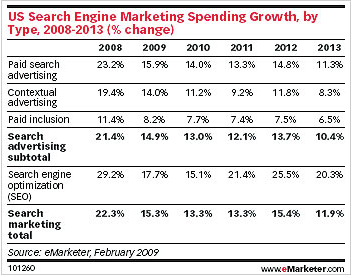
Search engine optimization (SEO) budgets are increasing as marketing executives gain knowledge of how SEO can benefit advertising and marketing campaigns. eMarketer is reporting that SEO budget allocations are expected to rise in the coming years as compared to other search marketing strategies.

With the decline in the economy, customer acquisition is becoming more and more vital. As the focus on customer acquisition increases, SEO becomes a more vital part of the overall marketing strategy. Because SEO provides a long term strategy for increased consumer presence, it has added value as compared to paid search marketing.

“Search Marketing Trends: Back to Basics” reports that SEO growth will grow from 17.7% to 20.3% while paid search will decline from 15.9% in 2009 to 11.3% in 2013. When searching for information, consumers find more value in organic search results than pay per click (PPC) advertising. The value placed by consumers on organic search results garners more clicks on these results thus making SEO a valued part of the marketing plan.

SEO Market Growth

SEO Market Growth

Combining SEO and PPC marketing efforts may result in higher search engine result rankings. Paid search engine advertising offers more immediate results, but in order to see results in the search engine arena advertising must be consistent. SEO marketing results occur over a longer time frame, but result in organic search results more valued by consumers.

In order to gain the most information and knowledge of your results, Web analytics is necessary. Having solid feedback regarding your SEO and PPC marketing efforts will allow you to gage how successful your campaign is. More traffic is only positive if the cost of the search ad relative to the conversion doesn’t reduce your bottom line.

SEO is a bit like a good public relations strategy; it helps to bring top of mind awareness to your site. SEO gets them in the door, so you can complete the deal.

Maximize Your Twitter

9:40 PM, Posted by Franken, No Comment

Twitter is expected to be one of the only social networking sites to have long term viability. Twitter usage and name recognition has been growing in leaps and bounds. Many are using Twitter not just to stay connected, but to market as well. So how do you maximize your Twitter?

Get an active Twitter account.

Yes it sounds basic, and you may already have one, but don’t just breeze past this section. We have some interesting tips to help you maximize your usage.

For those of you just getting started, open your account at http://twiter.com/signup. Once you have the registration form complete, connect with as many people as you can. They make it easy by allowing you to search your email lists (see below for more information). Customize your profile to show your main website and your, or your company’s, bio information. Don’t forget to set your location, update preferences and how you want to be notified of friends who have joined the Twitter revolution.

Draw attention with a customized background.

Get creative here. Simply click on “Settings” and then “Design” to choose a premade background or upload your own image. If you have a flair for design and a little Photoshop experience you can create a background that speaks volumes about you and your company. Check out some great custom layouts like:

http://twitter.com/JetBlue

http://twitter.com/BBCClick

http://twitter.com/MarthaStewart

Gather friends and follow interesting people and organizations

Finding friends on Twitter is easy. Three options are available.

1. Search Twitter. Use the “Find People” function to search for anyone from your next door neighbor to celebrities to companies.

2. Search other networks. Connect to anyone in your email contact list. Twitter can search through your hotmail.com, Gmail, Yahoo mail or AOL mail contact lists and if your friends use Twitter they can be added to your list.

3. Manual invites. Have friends, co-workers or clients who are not on Twitter? Manually input their email addresses and invite them to be your friend.

Connect your blog to Twitter

One of the best tools to connect Twitter and your blog was created by Alex King. This plug-in will automatically create micro blogs from your WordPress blog posts. Just follow this link for all the information

http://alexking.org/projects/wordpress

to download this plug-in click here

http://wordpress.org/extend/plugins/share-this/share-this.2.3.zip

If you blog regularly, be sure to review the instructions and support information.

Monitor your Twitter Rank

Twitter offers the Twitter Grader (http://twitter.grader.com) to show you where you rank against other Twitter members. Once you enter your user name, you will see where you rank among a possible 100 points.

Twitter Grading is based on overall rank, number of followers, your following and updates. The more active you are the higher you will rank.

Link your Twitter account to social bookmarking sites.

If you are in the Twitter game, be in it to win it. Build up your social networking account by bookmarking your Twitter account to sites such as Digg.com, Propeller.com, Dropjack.com and others.

Take advantage of advanced search features on Twitter

To really maximize your connection with people in your target market, go to http://search.twitter.com/advanced to use the Advanced Search features Twitter offers. In Advanced Search you can search by keywords or phrases, location, names and more.

Resist the urge to connect with everyone you see. Be choosy and select only the best people who actually have good information to share and are likely to accept your friend request.

As you take these steps to maximize your Twitter impact, you will see your social status rise. As with any adventure, the more you keep at it the better the result

Optimize Your Long Tail Keywords

9:39 PM, Posted by Franken, No Comment

We all prefer our customers to be serious shoppers with money ready to spend. There is nothing worse than wasting valuable time with a customer who isn’t serious about a purchase. Whether at your bricks and mortar location or your website, you want to draw motivated shoppers versus window shoppers. So how do you drive top quality traffic to your website? The kind of traffic that is ready to buy?

SEO (search engine optimization) is an excellent tool to build website traffic and top rankings on Google. But searching on any old keyword isn’t enough. To get the best prospects for your business, you need to focus on “long tail keywords”. Long tail keywords are keywords of three or more words. For example, searching on “cars” isn’t as effective as searching for “used cars for sale under $5,000”.

Long tail keywords work to your advantage because there is less competition for them. With long tail keywords, you get higher search engine rankings more easily. Most importantly, consumers who search for more specific things are more likely to be serious shoppers ready to spend their money.


The reasons to focus on long tail keywords are simple:

Focusing your SEO efforts on long tail keywords will over time, lead to more search engine traffic because you will have more pages indexed.

Long tail keywords will produce higher page rankings because there is less competition for them.
You will find your best prospects through long tail keywords. They’ve already taken the energy to think about what they specifically want or need; now they are on your site. These people are more likely to subscribe to your blog, email blasts and read your advertisements.

Long tail keywords generate higher sales. Shoppers who use long tail keywords are motivated and looking to spend money. Skip past the window shoppers and focus your energy on the serious shopper.

Focusing your SEO energy on long tail keywords will deliver the customer who is most likely to spend money at your site. Isn’t that what we all want?

Internet Marketing System

11:24 PM, Posted by Franken, No Comment

Do You Need an Internet Marketing System?
With the rise in online businesses and e-commerce, business owners have started to hear the phrase Internet Marketing and need to consider using an Internet Marketing system as opposed to a project-based system to effectively market their business. Without using a strategy to direct visitor traffic to their website, the site owner will not see any sales. By using strategies, the site's visibility increases, thus driving traffic and conversions.

What is Internet Marketing?

IM is the art of positioning a website to show up near the top of the search engine result pages (SERPs), and preferably in the top 10 positions on the first page. Many companies use professional SEO (professional search engine optimization) and SEM techniques to do this. Using various methods to supply backlinks to the target website, using proper keyword structure, and using fresh content are examples of techniques a professional search engine optimization company uses to increase visibility of a website.

SEM, otherwise known as professional search engine marketing services, includes SEO in addition to other methods such as pay-per-click advertising, sponsored advertising and more. Both methods increase overall visibility of a website and promote high visitor traffic so that the site can convert more sales.

Why Use Internet Marketing Companies?

Using Internet marketing companies as opposed to project based website development and marketing has many advantages. For example, an Internet marketing service provider will continue to update the professional search engine marketing services used, but project based services leave a business owner to tend to the SEO himself, if he has the time. An Internet marketing service provider will also turn the business website into an asset for generating sales leads and continuously use web-tracking services to assess a particular campaign's viability.

An SEO will also use website traffic tracking to monitor and analyze visitor behavior and change content to improve conversions related to the site's performance. This method is easy, but time-consuming and what site owner has the time to continuously monitor their site's statistics?

Opting to use a professional SEM or SEO company will not only have an effect on traffic and sales, but it will also effect the way visitors look at the site. They will see it properly maintained and know it is a site they can trust for fresh and reliable content and products. This is one of the many assets of using a professional Internet marketing service instead of a project based in-house approach for any SEO campaigns and web tracking services.

When it comes to Internet marketing services in San Jose, WSI Omega Solutions is your best choice for a professional Search Engine Optimization Company and web tracking services. They are a company that provides complete professional search engine marketing services and they take the hassle out of website traffic tracking and increase the return on investment overall.

SEO Tips for Your Marketing Campaign

10:03 PM, Posted by Franken, No Comment

17 SEO Tips for Your Marketing Campaign

When you begin your SEO campaign, it can be difficult to separate myth from truth. It seems everyone has different ideas of what works and what doesn't, and even someone who's been in the business awhile can get confused as SEO trends, tactics, and techniques change over the years.

While there may be much discrepancy, these 17 tips for SEO are something most experts seem to agree on. Following these rules, you can avoid some common mistakes and launch a successful campaign.

1. Perform keyword research. This is a very important step in your SEO campaign, before you even begin. Thoroughly research all keywords you may want to use - this can make a huge difference in your strategy.

2. Don't use the same Metas for every page. All your Meta and Title Tags should be unique for each page. Also, make sure to use keywords and write an engaging title.

3. Don't try to deceive the search engines. Don't overuse keywords, hide text, or create doorway pages. These are unethical forms of SEO. With the current trend of search engines favoring ethical SEO, your best practice is to create a well-thought out web page, that has unique content, and is easy to navigate.

4. Avoid low quality links. Not all links are created equal. Instead of getting links from link farms, research the popularity of websites before getting links from them. Alexa ranks are a good way to check popularity, as well as page rank. However, if your own page rank is rather low, fret not, for this will be explained below.

5. Avoid using links with the same anchor text. Search engines do not like links that use the same anchor text and description that are repeated in short bursts.

6. Don't overdo reciprocal links. Reciprocal linking can be valuable, but only when done in small doses, and if the links are relevant to your business. Also, make sure to have a diverse set of links, including links to blogs, forums, articles, social media bookmarking, and more.

7. Don't become obsessed with page rank. Page rank is only a small part of your entire SEO campaign. The way pages are ranked is actually rather complicated, and is based on many factors. It is possible for a lower ranked page to actually be quite successful and get lots of visitors. So if your page rank is low, don't freak out.

8. Do network with other Website owners. This is a great way to learn, get advice, and exchange links. These relationships can be mutually beneficial.

9. Make site updates regularly. Sometimes, an out-of-date website can be worse than no website at all. Make sure you update regularly with current information, news and events, and fresh content. If you want to catch the eye of the search engine robots, regular updates are a great way.

10. Don't compete for single keywords. Instead, compete for keyword phrases. This will make it more likely that your site will show up as a relevant search result. For instance, if your company sells jewelry boxes, and you attempt to compete for the term "boxes," many people who find your site will be looking for cardboard boxes, hat boxes, and other types of boxes, and will likely not stay on your page once they realize you don't sell what they're looking for. If you compete for the phrase "jewelry boxes," it's more likely that potential customers who are looking strictly for jewelry boxes will find you.

11. Research your competition. It's always good to know what the competition is up to, including what they are doing on their website, where they are getting links, etc.

12. Design your Website to be SEO friendly. There is definitely an SEO strategy when it comes to website design. Avoid heavy Flash and lots of graphics, since search engine robots crawl the text, not images. Good Meta and Title Tags are a must, as well as fresh and engaging content. If you're hiring someone to design your website, look for someone who is an expert in organic SEO.

13. Use text links instead of images. If using JavaScript, text links are important since spiders won't follow JavaScript.

14. Keep localization in mind. There are several benefits to reaching out to the local audience. Aside from gaining local customers, including location-based keyword phrases, like "detriot auto body shop," will help you because you will have less competition for that keyword.

15. Don't ignore the power of content. Nothing drives a Website like good content. Make sure your content is engaging, original, and well researched. Use keywords strategically (so they fit in with the natural flow of text).

16. Always proofread. This step should be a given, yet it's not uncommon to see typos and content mistakes on web pages. Aside from providing incorrect information, mistakes, as well as typos, make a web page and its company look unprofessional.

And most importantly...

17. Don't Give Up! SEO is not accomplished overnight. It can be a long process and takes lots of work and sometimes trial and error. Keep up your effort and don't give up!

Your Website Promotion

10:18 PM, Posted by Franken, No Comment

Website Free Promotion
You are welcome to A Promotion Guide. If this is your first visit, you might want to take the time to read through this page. I hope that the very important thing for those who has already created a web page or blog and have not yet any traffic to the resource is to read carefully this free step-by-step website promotion tutorial.

No doubts that your site is brand new and that you haven't done any website promotion work yet. Believe us that submitting of the url needs appropriate skills and ware. So, if you have submitted your link to a few search engines or registered your site with a couple of directories it will only gain a small practical effect.

You should know that the promoting of your site takes a lot of time and may involve waiting several weeks or even months to get into certain directories and search engines. Though, a great deal of them is commercial, but there are a lot of free ones. So, you must choose the way you want to register a link manually or using some special software. There is also another way to use assistance of the some special webs which guarantee quick and qualified submission of your link. Anyway the registration in search engines should be started at Google, Yahoo and Bing for free of charge.

But remember, that to Yahoo you can submit a link only in case you are registered and already have an account at Yahoo.com. Though, submitting to Yahoo you also automatically submitting your link to Altavista, AllTheWeb and some other engines as well. We recommend you to read an article about Yahoo-specific guidelines and hints on the internet too.

Here you find some links for free submission to search engines. Several other good links of the catalogues, classified directories and search engines are already given on the Artsgeo weblinks web page.

Thus, they say that “submitting to directories is easy and doesn't require much effort. It's ensuring that your submission will be accepted that makes this task a hard one.”

Very important is also to start submission with the Open Directory Project. While your site has to offer good and unique content to be accepted to the ODP. usually, its editors review sites quickly and won't reject them without a good reason. To mention a few, HotBot, Excite, Infoseek and Lycos submission is also very useful to claim their own share of the searching industry.

In the conclusion, we hope that the information you have read on this blog will give you some fresh ideas on how to improve your ranking and get more traffic to your site.

5 Tips for Marketing Through Content

10:06 PM, Posted by Franken, No Comment

Gather.com is a site that started as a social networking site, but is now a demand-driven media company, attracting 7 million unique visitors per month (and growing), according to the company. Demand-driven media is certainly a competitive industry these days with companies like Demand Media, AOL, Yahoo and others all playing their roles.

Tell us about your strategy for marketing through content.

Content has always been "where it's at", and that holds true as much as ever these days. Gather CEO Tom Gerace, who is also founder of the Social Media Advertising Consortium (SMAC), a non-profit organization working on the creation of standards for social media engagement campaigns, offered some tips on marketing through content to share with WebProNews readers. These tips are:

1. Start with Search. There are 15.9 billion searches run every month and a small percentage are customers looking for you and your competitors. Figure out your market opportunity by understanding how many searches, keywords and keyword phrases are related to what you do.

2. Think holistically about your budget. What do you spend today per customer? What is your average SEM spend? Content-based programs can help lower cost/customer acquisition because fewer people are doing it and competition, so far, is less intense. Plan to shift some budget dollars from SEM and other acquisition marketing efforts to content marketing - it delivers results with an improved cost structure.

Strategies for Making the Most of Your Data - Click Here Now

3. Target your content creation. Content needs to be targeted to areas that align directly with your brand; where sufficient demand for your content will make content marketing worthwhile.

4. Make lots and lots and lots of content at a low cost. Search engines weigh recency heavily when organizing content. There is always fresh content at the top of search results pages, so 1,000 posts on a topic will capture more customers than a competitor with 5 - 10 posts.

5. Don't go it alone. Managing dozens of writers, achieving top search engine placement, and establishing content creation costs to make content marketing make sense requires specialized knowledge and training. Find a partner and make them put their money where their mouth is on the numbers they promise.

Those are Gerace's tips, but I'll add that quality makes a difference. Not only does Google continually try to put more emphasis on quality with algorithm updates, but it also goes a long way when you're talking about reputation, and obviously you don't want to do something that will hurt your brand.

As far as search, Google's Matt Cutts has said of the recent Mayday update, for example, that content farms are among the kinds of sites that are hit the hardest by the alrogithm change. That's another reason why churning out sub-par content is not going to be in your best interest. If you can walk the line of delivering content that people are searching for, and giving them content that stands out, there are lots of benefits to be had.

9 Steps to Diagnosing Lost Search Engine Traffic

9:59 PM, Posted by Franken, No Comment

For the past few weeks I've been tasked with reviewing a few different sites that have seen a loss in traffic - their owners hoped to find out why. I love these kinds of reviews because it's like solving a mystery or figuring out a puzzle. While it's not always possible to determine the exact cause for the traffic loss, I can usually make some educated guesses based on what I dig up in Google Analytics.

Here are 9 steps you can take to diagnose the cause of lost search engine traffic:

1. Determine what type of traffic loss you're dealing with. Many people look at Google's overview page, see a loss of overall traffic to their website, and assume that they must have lost their rankings in Google and the targetéd traffic that comes with it. This may or may not be the case. Be sure to check for search engine traffic, and even more specifically Google non-paid traffic.

2. Look at the extent of the traffic loss. Your research will be very different depending on whether there was a gradual decline in traffic or a sudden, drastic drop. I reviewed a site last week that lost all of their Google unpaid traffic overnight! This sort of loss is typically a technical issue such as a robots.txt file or a nofollow directive that keeps search engine spiders from indexing your pages. Sometimes it's not actually a loss of traffic at all - your analytics code could have been inadvertently removed from all or most of the pages, making it appear like a traffic loss. I have seen all of the above more times than I can count in just the last couple of months!

3. Compare apples to apples. Many businesses are cyclical or seasonal. A gift site may see huge spikes in traffic the months leading up to Christmas or the weeks before other holidays. This means that comparing any month to the previous month may not tell you the whole story. A drop in traffic in January is probably fairly normal for a gift site. If you've got more than a year's worth of data, you'll want to compare this month's traffic to the same month in previous years. Ideally, you'd of course want to see a growth in traffic. And if you don't, then you may very well have a problem on your hands. If you don't have data that goes back that far, you can compare month to month, but be sure to take the data with a grain of salt.

4. Review and filter out "brand" traffic. Most websites get a lot of Google traffic from people who've typed some version of the name of their company as their search query. You'll want to note whether those visitors have significantly increased or decreased. If you receive fewer visitors for your brand, this could be caused by a decrease in marketing and advertising. Once you make note of the brand traffic, you'll want to filter it out so you can study actual keyword traffic, which is what real SEO traffic consists of.

5. Analyze which keyword phrases have had a significant decrease in visitors. Now that you've filtered out the brand traffic, you should be able to see the keyword phrases that are bringing you the most traffic. If you have lots, you may want to view 100 phrases at a time rather than the default of just 10. Are there lots of keyword phrases that seem to bring far fewer visitors over the last few months as compared to last year at the same time? You may also notice some that are bringing significantly more visitors.

6. Do a quick Google search for the phrases. If you're not seeing any pages from your site on the first page in Google, it may or may not be a clue (given the fact that everybody sees different search results) but it is definitely a cause to investigate further. If a page from your site does show up fairly high in the líst, it could just be that fewer people are searching for that phrase now as compared to before. Or it could be that your listing isn't quite what the searcher is looking for based on your title and descriptive snippet. There might also be other results for the keyword phrase that have images or video embedded whereas yours doesn't. Or there might be local map results showing up that make your result less appealing.

7. Review the landing page for the keyword phrase that lost traffic. Is there any obvious reason why it's not bringing in as many visitors as it used to? Does it even exist anymore? Did it change substantially at some point during the year? Did it get buried deeper into the site architecture for some reason? Is the content duplicated from other pages within your site or contained on other websites? Were there links pointing to it at some point that no longer are? Does the copy read naturally, or are there a few extra instances of the keyword phrase than really makes sense to a person?

8. Review your long-tail traffic. Since the end of April and early May 2010 a few large sites lost a substantial amount of traffic for keyword phrases that brought small numbers of visitors individually, but in aggregate they made up a lot of website traffic. You'll want to filter your keywords to those that have only a few visitors (even just 1) and see if there are significantly fewer of those than previously. If this is the case, Google has gone on record stating that they're doing a better job at sending long-tail traffic to more meaningful and relevant pages than they used to. Which means you'll have to go above and beyond what you're currently doing if you want to get that long-tail traffic back.

9. Decide if you're dealing with a search engine penalty. For drastic drops, in the rare cases where it's not a technical issue, you're most likely dealing with a penalty. You can check your Google Webmaster Tools account to see if there is a notification of a penalty, but they don't usually bother to tell you. Still, search engine penalties are much rarer than people think. In fact, most website owners know what they've done wrong when they have a search engine penalty. There are some cases, however, where they may have been duped by a less than scrupulous "SEO" company. The penalties I've seen seem to occur on sites that have no redeeming value because they have the same products and content that can be found on many other sites (often ones owned by the same company), plus they are deeply entrenched in massive link farms. It's likely that they are also hosting part of the link farm on their own site in the form of a link directory. If this is what you find, you may be better off to start from scratch rather than trying to salvage the penalized domain.

I hope these steps help you diagnose your loss of traffic. I imagine they will keep you busy for quite some time!

SEO Tips to Double Rankings

9:57 PM, Posted by Franken, No Comment

The only thing better than one search result in the top 3 positions in Google is two search results from a double ranking. This SEO tip works by pushing a competitor off the first page, broadening your websites keyword funnel and thereby doubling traffic and conversions.

Two Results are Better than One

I read somewhere that 87% of search engine traffic for a given keyword is allocated from occupying the Number 1 position in the search engine results page. If you understand SEO, then this post will share a quick method to double your SERP positions and to improve the likelihood of keyword conversions - once you have reached the Mecca for a specific search term.

SEO is predicated on one simple premise, rankings; in order for SEO to be effective, it must produce ranking on the first page in search engines.

Not only is this the crowning achievement of search engine optimization, but once you achieve a top 10 position, then you can pull other keywords into the spotlight as a result of strategic linking. We often refer to this as the buddy system for lateral linking.

Search engine algorithms pay particular attention to individual pages capable of offsetting all of the other inconsistencies of a competitor's web pages and deem one page worthy above all others for any given search term.

Obviously the metrics are unique for each market, keyword or niche, but the reality is the same, once a top 3 or more importantly Number 1 or Number 1, 2 and 3 positions are present in Google. I have mentioned before, the fastest way to get a top 10 position in Google is to get a link from a website already ranking in the top 10 for that keyword.

It does not matter if that link is provided from your website or another website, rankings are by the page and there is a daisy-chain effect of linking pages together that fuses the pages through a dynamic give and take relationship (based on citation). This citation can provide the algorithmic equivalents of trust needed for the newly linked page to jump in line past others duking it out for that keyword.

Depending on the competitiveness of the keyword or key phrase and the thresholds inherent to the barrier to entry; the time required to initiate a campaign, create all of the necessary content, inbound links and citation from other web 2.0 properties, RSS feeds and social bookmarking sites divided by the amount of time you invest managing or outsourcing the various components involved determine your profitability and return on investment.

With this in mind, from a tactical perspective, it's better to leverage the SERP positioning you already have than to look outside of your website for off page ranking factors. If you understand the power of a Number 1 position, then you can replicate this next simple SEO tip.

Identify all current Number 1 positions in Google for keywords.

Validate they still exist.

Use Keyword Research to find "related keywords" based on the Number 1 ranking Link from the page that ranks to a new page (using similar anchor text or overlapping keywords to promote the new page).

Let the new page get indexed, then check the SERPs.

Identify: My favorite tool for this is SEMRush, but if you don't want to use this, there are other programs out there, or even Google webmaster tools can show you your website's top ranking SERP positions when you log in.

Either way, this is your base, so, identify the keywords which could represent hub status for your SEO campaign and pass along the power of ranking to other pages in your website.

Validate: Check to see if you still hold the Number 1 position, even a top 3 will do, but this tactic works better if you are at the helm of a particular search phrase.

Keyword Research: You should be able to gauge whether or not the keyword is profitable for you based on the frequency of hits and the type of traffic you garner as a result. You can always look through Google Analytics or whichever analytics package you have to assess the keywords that represent the highest percentage of traffic to your website.

Once you know what those keywords are, then use keyword research to find stemmed semantic variations that also fall under the same category or keyword cluster. Those related keywords will become the new focal point for step 4 - linking.

Linking: The closer the shingles (groups of keywords) the more effective this technique is. You can call this padding the search results (if you use similar exact match titles, tags or content), or you can pass this ranking factor along to help synonymous terms.

Simply go back and edit the page ranking in the Number 1 position and add a link to the new target page (with the keyword you intend the target page to rank for as the anchor text). Then, the authority from the page in the Number 1 position will gróup the new page under its umbrella and pull that page into the spotlight.

When the new page gets crawled and the old page reveals the connectivity between the two, typically a double SERP position occurs or a double position accompanied by jump links, breadcrumbs or the [+] with additional search results for that keyword appear in Google to showcase the degree of relevance your website has for the said term.

You can then build additional deep links from other sites or addition internal links to the newly dubbed page. As a result, you should see buoyancy for other pages for multiple keyword variations related to the parent keyword cluster.

With this simple tip you can double your conversions by increasing your website's semantic array of keywords. Obviously you will know which keywords and traffic is most lucrative for your business model, but this technique is priceless for creating controlled keyword stemming if you understand the implications underlying its premise.

How Much Do You Know About SEO

9:50 PM, Posted by Franken, No Comment

So just what do you know about SEO? When it comes to SEO are you a Novice, Intermediate or Expert? Regardless of your level, this article from a 10 year SEO war veteran may prove helpful.

One of my biggest problems in trying to help other webmasters - I naturally and wrongly assume they know all about SEO. I forget these webmasters have not spent the last 10 years battling it out with other online webmasters and marketers for some very popular and lucrative keywords, in the process, honing their SEO skills with other like-minded individuals.

I forget that many beginning webmasters may not be familiar with all the SEO lingo and SEO techniques which I mention in my articles.

There's nothing wrong with that. If I were to take up a new hobby or explore a new subject, I am sure I would be just as clueless. Mainly because every subject, sport or hobby comes with a lot of terms/phrases which are unique to that subject. SEO is the same way so maybe a little background or warm-up is needed in regards to understanding the basics of SEO.

Tip: If you're a complete novice, a complete list of the SEO terms might prove helpful. You can find a complete SEO Dictionary at: www.submitexpress.com/seodictionary.html

First, you must understand that SEO stands for Search Engine Optimization... which means you optimize your website and content so that it ranks high in the major search engines such as Google and Bing/Yahoo. This optimization can take the form of following a strict formula or layout of your website content with the proper meta tags, keyword density, linking structures and so on. It can also mean off-site optimization with link building, right anchor text, keyword positioning and so on.

SEO has become a major industry simply because getting top rankings for lucrative keywords can mean significant revenue for companies or individuals. We are talking about billions, if not trillions of dollars, exchanging hands with the sale of products, services and business transactions. Get a top ranking for your chosen keyword phrase and it means a flood of targeted prospects/buyers coming to your website or company, ready to do business.

Now, because there is so much money involved, a whole SEO industry has sprung up with consultants, experts and companies offering their services to get you or your company into those top rankings in the search engines. These SEO services could include link building, link buying, social media positioning, onpage optimization, pay-per-click management... all with the goal of bringing targeted customers to your site or business.

White Hat vs Black Hat SEO

You may also have heard other webmasters talking about White Hat SEO as opposed to Black Hat SEO. And as the names suggest, White Hat is strictly above board proper site optimization, while Black hat is using underhand devious cloaking methods and systems to raise your rankings. For obvious reasons, always go the White Hat route and you will feel better knowing you're doing the right thing in regards to your site.

Perhaps the next concept or term you should know is Algorithm. Search engines create complicated algorithms or lists of rules which determine not only how web pages are listed but also which web pages are listed first in their index or SERPs (Search Engine Results Pages). These rules or ranking factors are used by SEO experts and webmasters to help move their keyword rankings up in the search engines. You open a web browser, go to a search engine such as Google, type in a search query for "top corporate lawyers" and the search engine returns a list of organic results along with a list of paid listings. Now, getting to that top spot means a lot of potential traffic/clients would be coming your way.

This is just one example, but most people quickly realize how lucrative getting to those top spots is for any individual or company. They also realize that understanding how the search engine algorithms work and how to manipulate them is a valuable skill for which many clients will pay big moolah to have on their side. This SEO industry also consists of SEO software which helps webmasters/marketers get their sites into the top positions in the search engines.

Most SEO experts break up your search engine optimization into TWO TYPES:

On-Page and Off-Page Optimization

On-Page Optimization means getting right all the factors which influence your rankings in the search engines. Keep in mind, the whole web is "keyword based and keyword driven" which means you must optimize your domain and site for your chosen keywords. Your main keyword should be in your Domain Name, in the title of the page, in the main heading for that page, in the URL and it should appear (with variations) throughout the page. Try to keep the keyword density to around 2%-5%, although like many things to do with SEO... there are varying opinions on the exact percentage. But what most experts agree on: the layout or structure of your web site or pages must be easily reached not only by your visitors but also by the search engine spiders which crawl your site. Keep it simple - have no links more than three clicks away from your homepage. Many webmasters include a link back to their homepage on EVERY page of their sites.

Off-Page Optimization means building backlinks flowing back to your web site or web pages. Regardless of what anyone will tell you, getting quality keyworded links from other high quality keyword related sites is the most important factor in achieving top rankings in the search engines. So link building should be a major part of your SEO efforts and something which will bring the fastest results. These links must appear natural and organic so varying the anchor text (underlined part) in your links is important. Also, the web is quickly changing, links from social media sites such as FaceBook, MySpace, Twitter are becoming more helpful to getting top rankings. So too, are links from blogs especially those from Blogger and Wordpress because these are optimized for keywords. Don't forget other media forms such as videos since links from sites such as YouTube can also boost your rankings.

Blog Keyword Strategy

11:08 PM, Posted by Franken, No Comment

Keywords play a major role in failure or success of any website as well as link building campaign. To run an effective link building campaign, you should research about the best keywords for your website. These keywords will be used in your site content as well as in anchor text of the incoming links for your website. But the question is how to choose the best and effective keywords for your website? Lets start our keyword hunt…

Remember that If you don’t choose the right keyword in the very first step, then it will undermine everything else you do later. Well, you are right! Why is your keyword so important?

Basically targeted visitors use search engines to find information using keywords. Choosing an effective keyword will help ensure that you targeted the right topic that someone actually wants to read. Here targeted visitors are the people that you most want to find and read your website. They are the internet surfers who are most likely to be interested in the service or product of your company and the most likely to respond by clicking through to your site.

Most of your targeted visitors will find your website by performing a search in one of the search engines. They will search for the keyword or words that make the most sense to them when they are looking for information. Your goal is to find the keyword that your targeted readers will most likely search under to find the information or the product that you are offering at your website. Use words that people are searching. Choosing a right keyword will ensure that your targeted visitors will take real interest in your website..

The basic and first step in finding effective keywords is putting yourself in your visitors’ shoes. Think about who they are and in what they’re interested in. If you run a website dedicated to pet food, then you wouldn’t want a visitor coming from the term online dating. Once you make a list of all the term you can think a visitor can use to find a site like yours, move to the second part of keyword research.

You can make your keyword list bigger by exploring your service or product with different angles. Let’s say you are selling Leather jackets. You can explore the need and objective areas of the product. Why anyone wanted a leather jacket? What exactly is its purpose and what purpose its fulfilling. You can also increase your keywords by categorizing your product in terms of color, size, etc.

Once you got a complete list of keywords that you can think of, go to keyword tools like wordtracker and Google Adword Keyword Tool. See the search counts of your keywords and competition against it. Your sheet may look like this after this work.

Keyword WordTracker Counts Google Adword keyword Tool Competition Target Page
Word 1
Word 2
Remove the low count/searches keywords. Target the three worded keywords or phrases first. The two worded keywords in the mean time will get some rank automatically and then it will be easy to rank them on top positions. Consider the competition and competing sites. Once you finalized your keyword list, you can then move on to utilize these keywords as per there respective target page.

In the upcoming article we will discuss on how to utilize these keywords effectively. So stay tuned.

Increase Web Site Traffic

11:05 PM, Posted by Franken, No Comment

Have you been searching for the best ways how to Increase Web Traffic and you just end up more and more confused? There are so many online marketing solutions out there making endless claims that they will increase your website traffic with higher search engine rankings and a flood of visitors. The truth about getting web site traffic is that you need a very diverse tactic to outpace your competition. Avoid tuning in to the “experts” who have got some brand new method that they are promoting each and every week. Many of the self proclaimed experts are only experts at promoting a new product launch every week and not so much on true ways to increase web traffic. Don’t focus too much on any one method. Learn a variety of useful methods to assist your search engine rankings as well as your immediate traffic.

Increase Web Site Traffic with Variety

If you are trying to achieve success in the internet marketing industry you will have to outpace your competitors and find every source of traffic that is out there. When you can squeeze more targeted traffic and increase the visitors to your web site with a variety of methods you can end up on the top. One of the better strategies is by using strategies that will improve your serps with SEO and also drive traffic directly to your website. Article marketing is an example where one can not just submit your articles for syndication but you will also gain valuable backlinks that can improve your search engine rank for your keywords.

Increase Traffic with Article Marketing

Using article marketing to increase web site traffic is one of the best ways to start out. Creating original content and then submitting to top 10 article publication sites will get immediate traffic from the articles and will help your long-term strategy to gain better rankings in the search engines. Make sure to submit to the top article publication sites that have a high page ranking domain as these will get the most traffic, they get indexed faster, and these articles will give you a more powerful back-link. By utilizing article marketing to increase your website traffic there is definitely strength in numbers, so use an article submitter to send out to hundreds of directories.

Increase website traffic with Social Bookmarking

Social bookmark submitting to increase web traffic is an absolute must these days. The only issue is most internet marketers don’t know how to apply it correctly. One of the best uses of social bookmarking is not spending all your time bookmarking your main site, but bookmarking your articles and backlinks. Use social bookmarking to build deep links which will increase the PR of your articles and backlinks adding more overall SEO power to increase web site traffic. Social bookmarking is important but don’t get caught up all day bookmarking sites as you will not be making the best usage of your time. Increase website traffic with social bookmarking by putting aside no more than 10% of your total time for this task.

RSS Marketing Website Traffic

RSS is the most powerful and most underutilized method to increase website traffic. When most people think of RSS they think of a directory full of submissions that can be read. The benefits of RSS are a lot more complex if you use it correctly. RSS may be used to create thousands of backlinks, can be used to create fresh content on your websites, and can be used to create affiliate product feeds mixed with content. The power of RSS is amazing but and if you neglect it you will be missing out on absolutely enormous potential to make money and increase web traffic using RSS strategies.

Increase Web Traffic with Blog Comments

The ability to leave comments on blogs has made it easier for the average internet marketer to get some quick backlinks. The only problem is that most people fall into the trap of spending way too much time searching for blogs and doing Google searches looking for blogs that allow comments with dofollow. Using blog comments to increase website traffic is a great strategy but not if it takes up more than 10% of your time. Go for either high traffic relevant blogs that can give you some immediate traffic or find high PR blog comment pages where you can leave an SEO optimized anchor text. This will give you an SEO boost but eventually it will lose its juice from other people posting. Use blog comments to increase website traffic directly and with offsite SEO backlinking.

You can make some great money online with organic search traffic from Google but you might find your greatest challenge is finding which methods to use and how much time to spend on each one. Form a concise plan that you will follow so that you don’t get sidetracked spending an entire day social bookmarking when you really needed to create more content for syndication. Finding a balanced strategy is the best way to increase search traffic and make money with your internet marketing business.

Do-It-Yourself SEO

9:39 PM, Posted by Franken, No Comment

Do-It-Yourself SEO with a Foolproof Twist
As the founder of an independent SEO firm I am asked almost daily "What is the easiest way to optimize a web site?" It is harder to answer than you might think. It depends on who is asking and what their knowledge or experience level is. But last week I read an article written by the person who taught me search engine optimization ten years ago, and I now have an answer... Learn the secret recipe, then use it.

There is no magic bullet that works on every web page like so many SEO 'miracle' books and programs would have us believe. Each page has its own unique 'secret recipe' that has to be discovered and then applied because every single page it is trying to outrank, is unique. If this seems confusing, just remember my new favorite quote that I borrowed from that author's website: "Think about it. Anyone could bake Mrs. Fields famous cookies - possibly better than Mrs. Fields herself - with the secret recipe. And that's all SEO is; knowing the secret recipe for any given web page."

And it really is that simple. We will look at how to discover the secret recipe in a moment, but first there is one crucial thing to understand about search engine optimization before you go any further:

SEO means making a web page as highly visible as possible to search engines... for a given keyword.

Just about everybody knows the first part; but too many people forget the second.

Remember that your soon to be visitor types in very specific keywords (search terms) on search engines like Google, because they are looking for something very specific.

If you know your most important keyword that is great! If not, do not waste your money on expensive keyword software that SEO professionals use. Use a free keyword tool like Google's, found at:
https://adwords.google.com/select/KeywordToolExternal


Just enter in the keywords that you think people are searching for to find your product or service and then check the search numbers for those and related keyword suggestions.

So what about the secret recipe? Once you know your main keyword or keywords you need to see how well your site is optimized for that term already. This is called getting your SEO Quality Score.

What you do is make a list of the most important optimization aspects of a webpage, for the search engine of your choice (because Google looks for different things than Yahoo or Bing.)

Here are ten critical factors for Google, but there are nearly 140 to be aware of...

• Keyword use in document title
• Keyword use in body text
• Link texts of inbound links
• Global link popularity of web site
• Keyword density
• Keyword position and proximity
• Number of words
• Readability level of web page
• Keyword use in H1 headline texts
• HTML validation of web page to W3C standards

Once you have all of this information for your webpage, you need to get it for the pages currently occupying the top ten positions for that keyword and then see how your page compares.

You can buy software that does a lot of this for you but it generally costs $500 to $2,500 for the ones that really work and even then you might need to buy an hour of an SEO consultant's time to help you really understand it.

Doing it yourself is very educational. You will be an SEO pro after a couple of these. So if you have the time, I would not hesitate.

In my case I did not have the time - or let's be honest, the patience - to invest what would be 20 plus hours doing this manually and not really understanding what I was looking for. At the time I was a lawn sprinkler installer looking to optimize my company webpage and knew nothing about SEO, except that it was too expensive for me to hire someone else to do it. So I went the cheap and easy route paying a company called DotCom Pirates $50 for something they called their SEO To Go package that reviewed my site for all 140 SEO factors and provided plain English instructions to fix every aspect of it. I did most of them and hit number two on Google.

Here's my dirty little secret... Realizing this was much easier than breaking my back in irrigation, I picked up a couple local shops as SEO customers, ordered reports for those sites, followed the directions and my SEO business was born. I no longer need their help, but it made for some easy success when I needed it most.

Knowing the secret recipe is the foolproof answer to DIY SEO. Once you have the secret recipe it's easier than you ever thought possible and you'll be laughing all the way to the bank with the money you saved.

SEO Vs Pay Per Click

4:35 AM, Posted by Franken, No Comment

Most business owners today are advertising to the fullest of their capacity. The most successful businesses usually have money in their budget set aside for marketing and advertising. Those with bigger budgets are able to spend money advertising in all kinds of different ways. But many small businesses don't have the money to advertise on a large scale. Some of them can only afford one way and must choose which way this is to be. If you're thinking about advertising on the internet, then this likely comes down to a question of SEO vs. pay per click - a brief discussion should help you to decide which option is right for you.

Search engine optimization, or SEO, is a way to make your website search-engine-friendly. When finding search results, search engines are looking for pretty specific things. By making sure that your website fits as many of the search engine's criteria as possible, you'll make sure that your site comes up first in searches for keywords pertaining to your business and the products and services that you offer. If it's more important to you that you rank higher in search engine results, then you should definitely invest in SEO. In the battle of SEO vs. pay per click - a brief discussion about your advertising goals are in order.

Pay per click is a type of internet advertising that allows you to pay a search engine for ad space in searches for keywords pertaining to your site. You'll often notice this sort of space at the sides and top of a page of search results. The placement of your ad will depend on your business' relevance to the search term as well as the amount of money you're paying for the service, as premium spots cost more. But when it comes to SEO vs. pay per click - a brief discussion will show you how much you're willing to spend for prime real estate on a page.

But since the placement of your ad also depends on the relevance of your search term, SEO is relevant even when you're using pay per click advertising. Because of this, you may want to use both in your hunt for the perfect internet advertising campaign. So, bottom line: SEO vs. pay per click - a brief discussion may show that both of them are worth the time and money, and that you may want to figure out a way to fit both into your budget.

Link Wheel

4:34 AM, Posted by Franken, No Comment

Typing "Link Wheel" as a search query into Google returns 381,000 results. Search in web hosting forums for keywords "Link Wheel" and you'd get lots of varied opinions. So what is a link wheel and how does it relate to SEO? And is it a white hat or black hat SEO tactic? Could it lead to search engine penalties?

White Hat?

To a lot of webmasters and SEO experts, link wheels are a valid SEO strategy (white hat). Link wheels are essentially a wheel of linked websites (all yours), designed to improve the SERPS (search engine results pages) of your main site. In this multiple sites are developed with each linking back (one-way) to the main site, and linking to another related site (within the same niche).

Black Hat?

To take this even further, some SEO experts recommend using IP addresses from different class C IP allocations for each site. My take on the IP's? This seems to be a black hat strategy to avoid Google penalties. Why? Because a lot of link wheels are composed of one-post blogs that offer little or no relevance to a search query. Their intent? To trick Google into seeing multiple links back to their main site. Many say this works, but only until you get caught, and then all that effort goes to waste.

Relevance is the key

I don't think I'm all that different from most folks searching for information on the Internet. When I search for colocation, I expect to find sites with great content related to colocation. It's frustrating to find sites with no real content, or simply links to other websites. The same applies for Google. They have a ton of advertising dollars at risk, and have developed very sophisticated search algorithms to emphasize and reward relevance.